Read an article about me in the Peace Corps on the UCSD Website News Page at:
http://ucsdnews.ucsd.edu/newsrel/general/02-09PeaceCorps.asp
Wednesday, April 14, 2010

Jeeves the Cat

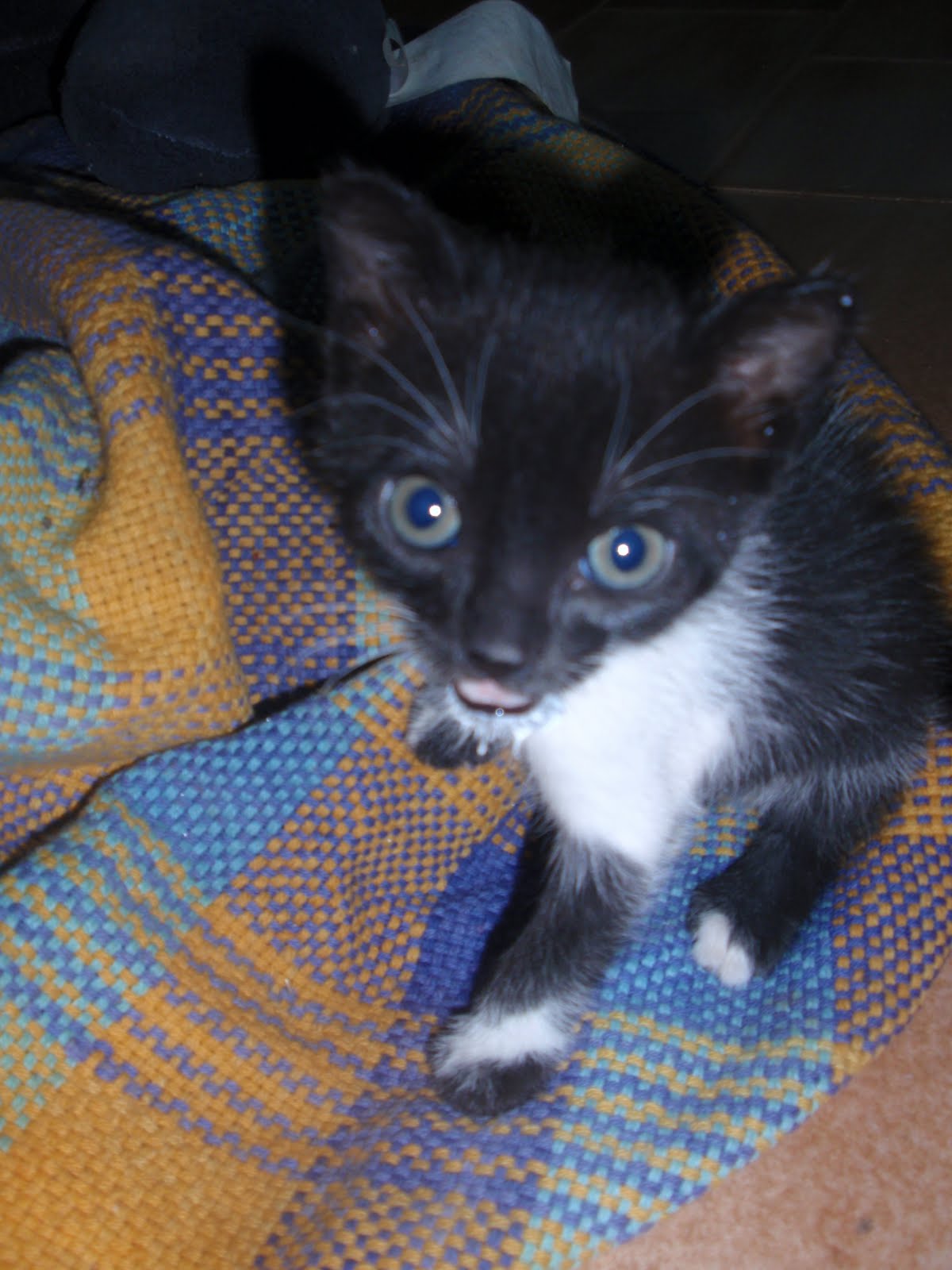
I got a kitty! His name is Jeeves. He is a little six-week-old, black and white kitten. I have had him a week and already I feel like I am raising a baby. But I have grown so attached to him. He requires constant attention, cries a lot and drinks lots of milk. He is very active and just wants to play.
Now that the time has changed and it gets dark at 6 o’clock and everyone is indoors at this time, he makes the long nights feel a little less lonely. He is my new little baby!
World Map Project

I have a few projects going on right now but by far my favorite is the world map project. If you want to understand the background of the map project you can read this article…http://www.peacecorps.gov/index.cfm?shell=resources.media.medstories.view&news_id=1536
The idea of the map project is to paint a giant world map mural on a wall in a central location in town to teach kids and everyone else about geography and Paraguay’s relations to the world. In general, most Paraguayans know very little about world geography and I have been asked a lot of interesting questions about geography during my service. But, not until I started painting this map did I realize how unaware Paraguayans are of the world surrounding them. It has been an eye opening experience to say the least.
I decided to paint the map on the wall of the library, the municipal library almost no one knows exists. It is a dreary place and has about 100 dusty books that no one ever looks at. The place remains locked up most of the time and is attended by the town “librarian”, a bitter Brazilian woman who comes to work when she feels like it and is only nice to the young, cute boys.
The youth group was fixing up the plaza where the library stands the weeks before school started, which was my perfect opportunity to get kids involved in my map. Kids where hanging out at the plaza all day and every day to fix up the decrepit old plaza around the library, because lets face it there was nothing else to do, and so I was able to spark some interest in the map project.
The process for creating the map is pretty simple. Peace Corps has published a handbook with everything you could ever need to know about making the map. First I petitioned the municipality for supplies and then got to work. Day one we painted the dirty, disgusting and grafitied wall a beautiful blue. We painted two coats, a new concept. The handbook has formulas and graphics that demonstrate how big to make the map and how to center it on the wall and all other logistics. With the formulas we figured our map to be 3 meters by 1 ½ meters. We were going to draw the map using the grid method, meaning, small box by small box we would trace the world onto the eastern wall of the library. But first we had to draw each individual box, over 1500 boxes actually. Each box was to be 5 cm by 5 cm. So with a meter stick I marked out every 5 cms along the left border and bottom border and then very tediously drew lines up and down the wall all day long. The kids took turns helping me. It was very time consuming.
Then we started to draw. I was recruiting kids from the park to help out. A lot of kids would look on in interest but recoil in fear when I would ask them to actually participate claiming they didn’t know how to draw. I tried to explain the brilliance of the grid method was that you didn’t have to know how to draw but some would still refuse. Paraguayans are afraid of new things so I didn’t try to push them to much. But I still had a lot of participants that would practice drawing on the handouts I gave out and then move on to the wall. Some kids were great drawers and saw quickly how easy and fun it was. A lot of people would walk by and assume I had drawn the whole thing myself. Because I am the Americans they assume I know all and can do all, therefore I must be a professional drawer and painter as well. It doesn’t matter how many time I repeat that I don’t draw or paint they don’t really believe me. Actually, I only contributed a small part, the kids have done a lot themselves. I always supervised but they were the bulk of the input.
Now that the kids are in school I am most likely to get participants in the late afternoon, around 5 o’clock. I can always show up to the library and get out my supplies and within thirty second find myself surrounded by a few kids firing away with questions. Usually these kids are too little to actually put paint to the wall but they love to watch and touch all the paint supplies. But I can always tempt some older kids passing through to lend me a hand.
The map project has been a great way for me to get to know a lot of kids in Fassardi. I have spent so many hours at the library/park where these kids hang out and I have been incorporated into their world. Now while working on the map I have lots of little voices calling my name asking me a million questions, asking me to look here, look there, look at this, to borrow my bike, how you say words in English …..
After one long day of painting and lounging in the shade, two little girls that almost never leave my side scraped all the paint off my hands and arms. They were determined to get every last drop of paint.
The most eye opening part of this whole project has been the questions I have tried to answer about geography. I knew Paraguayans knowledge of the world was minimal, but throughout this process I have begun to slowly see how uneducated they really are. A lot of people understand that I am painting a world map but some do not. I have had a few people ask me what the map is of exactly. As Americans, we have grown up with the image of the world map, I am sure you can conjure up a mental image of it right now and possibly draw an outline of the continents yourself but in the last few weeks I encountered Paraguayans who had never seen this image of a world map before! They had no idea what they were looking at.
Also, looking at and reading maps comes very naturally to us, you probably don’t even remember when you were taught how to look at a map, but I promise you it happened sometimes when you were a kid. Most Paraguayans out in the campo never had this privilege. I thought kids could look at the map in the handbook, pick a country to paint, and then go ahead and paint it. I was wrong on this account. Most kids have been unable to do this, they get lost between the small map in their hands and the big map on the wall even though the picture is the same. The idea of looking at and comparing maps is so new and can be so disorienting for them. For example, once two kids were looking in the book at the map of Europe and pointing to a country in Africa assuming they had found the same country in the book, assuming a map is a map and not realizing they looked completely different. Or I will point to a country on the wall and outline the border with my fingers and show them exactly where they are going to paint, they will say ok, go get the paint and paintbrush, come back to the wall and have forgotten which country they are supposed to paint.
The map project is almost completed. Right now we are in the process of erasing the grid lines. The next steps are to repaint the oceans, label the countries, and finally paint a clear protective varnish coat and then we will be done! Creating the map itself has been a unique and rewarding experience, but this is just the beginning. I have big plans for the map once it is completed. I am planning to teach interactive geography lessons using the map with the high school and elementary schools classes. I always loved geography lessons when I was in school so I am excited to create fun and interactive lessons using the map. Think of the potential for what these kids could learn.
Sunday, January 24, 2010
The Toughest Job You Will Ever Love
I know my blogs over the last few months have become less frequent but as I have begun to slip into my day-to-day life in Paraguay I have found some kind of a routine: an everyday life that is not as interesting and new as I used to find it and therefore I find myself with less than fascinating circumstances to write about. Paraguay and Paraguayans still never cease to amaze me and I still find myself learning a lot but my ability to accept the cultural differences as norm and not dwell on these differences as much as I used to is much greater. In fact, I find myself starting to pick up on a lot of cultural habits, whether I realized I was doing it at first or not. For example, Paraguayans are a bunch of liars. I’m not being offensive, its just their way of trying not to be offensive. Paraguayans are characteristically timid, passive and will go out of their way not to offend, so saying ‘no’ to any kind of request sounds like a great offense. To avoid any confrontation or awkwardness, Paraguayans say ‘yes’ to everything, even when they mean no. I can invite the whole neighborhood to a meeting at my house the next night and get a positive ‘yes, I will be there’ from everybody and have nobody show up. I have found myself becoming quite the liar as well. I tell people, “yes, I will come visit you tomorrow”. Even when I know I have no intention of going over there. I here ‘yes’ so much that it has just started to flow from my own mouth. The Peace Corps has made me a liar.
I also have not been writing as much because life in Paraguay the last month or two has been somewhat of a struggle for me. I am very content with my lifestyle and wouldn’t want to give it up for a second. In fact, the thought of going back to the States and having to LIVE and find a JOB there sounds pretty dreadful to me. And although some of my PC friends refer to their service as ‘two years of summer camp’ (and sometimes I have to agree with them) life in Paraguay and the Peace Corps isn’t always easy. It has its ups and downs, and this past month or two has been a down for me. It could be because of so many factors. It could be because its summer vacation, the kids are not in school and the overall pace of life is small pueblo Paraguay is even slower (if that is at all possible), that also means I have to wait till classes begin again in the end of February till I can start up all the projects I would like to do with the schools…oh so many ideas.
It could be because it is the dead of summer and the heat is relentless and unmotivating. No wonder Paraguayans are stereotyped as lazy, the sun is way too hot to go outside and do anything most days. I have never experienced such continual, intense, humid heat before. I understand the need for a siesta in the middle of the day. The heat takes away all your strength and energy and there is nothing to do but sleep after lunch with this kind of weather. I couldn’t have imagined it until I actually experienced it myself.
It could be because people in Fassardi are still trying to understand what the heck I am doing here. So far I haven’t tried to convert them and I haven’t given them any money like all the other white people that have come through here in the past. All they know is I rented a house, I talk funny, and I haven’t left yet. They are still a little suspicious. In this manner I am having a difficult time finding people to work with me. Paraguayans are extremely friendly and open and they will call to me from the street and invite me into their homes. They will offer me food and what little they have. They will ask me lots of questions and I will talk to them about my ideas for projects and ways to improve their community but I still have yet to find people who are really willing to back me up and support me. Maybe they have heard this kind of talk before and nothing happened. Maybe hope is a dangerous feeling to have lingering.
Maybe it is because it is difficult for people to really understand me. Yes, I speak Spanish and I can speak it well. But I am not fluent. Who knows if I ever will be. I still make mistakes all the times, find myself stumbling over words, and still find myself in situations where I cannot express certain ideas or concepts. This is the most frustrating of all.
Maybe it is because living in a foreign culture is a difficult thing to do, something I have to remind myself, away from all I know that is comfortable and meaningful. Peace Corps is a 24/7 job, I can never escape it, I never get a break from my job. Even when I am alone in my house at night, Fassardi is dark and quite, and I think I can relish for just awhile in some of my American ways I will turn around and there will be Paraguay, still in my house, staring me in the face. A storm passes over the house in the middle of the night and the power goes out, my fan shuts off and I have to pass the night in a sleepless sweat, I want to cook dinner on my gas stove and realize my tank is empty, the water is cut and who knows when it is coming back on, I want to go to bed a little early one night but the Evangelical church down the road has a different idea and the pastor blasts his preaching accompanied by loud reggaton music over the loudspeakers into the night, some creepy dude in town has gotten a hold of my cell phone number passed from this guy to this guy to this guy and sends me anonymous love text messages.
Paraguay never goes away. My boyfriend likes to say we as foreigners are in a constant battle with Paraguay and if I don’t start to fight back Paraguay is going to win. Paraguay wins tiny battles everyday. Especially over my health. I have had countless, unidentified insects bite me that swell up to the size of a baseball. I have also had numerous unidentified ailments that have had me on my back for more than a day or two. Paraguay sure had its way with me on those occasions.
Peace Corps Paraguay PTO Jason Cochran put it best. He says you have to think about your “Little Victories”. He gave me and my fellow training group a pep talk during our three month in-service training and reminded us during all of our bitching that Peace Corps is a hard job, its supposed to be, but it’s the little victories that count and those victories are different for everyone. If you are having trouble just figuring out how to light your damn Paraguayan oven and you finally figure it out, that is quite a little victory. I have really taken his words to heart and although I think his words of wisdom can apply to anybody they really do make sense for our situation in the Peace Corps and I like to think about my little victories everyday. This strategy really helps me get through the day.
I also might just need a vacation. So my boyfriend, Adam, and I are going to northern Argentina for a week. Yeah! I am going to leave Paraguay behind and forget about it for just a second. Take a break. I’ve been working for the past eight months, I think I deserve a vacation!
But if this job was easy I wouldn’t like it, I never would have signed up. Peace Corps says it is the Toughest Job You Will Ever Love, and no slogan could ever be truer.
I also have not been writing as much because life in Paraguay the last month or two has been somewhat of a struggle for me. I am very content with my lifestyle and wouldn’t want to give it up for a second. In fact, the thought of going back to the States and having to LIVE and find a JOB there sounds pretty dreadful to me. And although some of my PC friends refer to their service as ‘two years of summer camp’ (and sometimes I have to agree with them) life in Paraguay and the Peace Corps isn’t always easy. It has its ups and downs, and this past month or two has been a down for me. It could be because of so many factors. It could be because its summer vacation, the kids are not in school and the overall pace of life is small pueblo Paraguay is even slower (if that is at all possible), that also means I have to wait till classes begin again in the end of February till I can start up all the projects I would like to do with the schools…oh so many ideas.
It could be because it is the dead of summer and the heat is relentless and unmotivating. No wonder Paraguayans are stereotyped as lazy, the sun is way too hot to go outside and do anything most days. I have never experienced such continual, intense, humid heat before. I understand the need for a siesta in the middle of the day. The heat takes away all your strength and energy and there is nothing to do but sleep after lunch with this kind of weather. I couldn’t have imagined it until I actually experienced it myself.
It could be because people in Fassardi are still trying to understand what the heck I am doing here. So far I haven’t tried to convert them and I haven’t given them any money like all the other white people that have come through here in the past. All they know is I rented a house, I talk funny, and I haven’t left yet. They are still a little suspicious. In this manner I am having a difficult time finding people to work with me. Paraguayans are extremely friendly and open and they will call to me from the street and invite me into their homes. They will offer me food and what little they have. They will ask me lots of questions and I will talk to them about my ideas for projects and ways to improve their community but I still have yet to find people who are really willing to back me up and support me. Maybe they have heard this kind of talk before and nothing happened. Maybe hope is a dangerous feeling to have lingering.
Maybe it is because it is difficult for people to really understand me. Yes, I speak Spanish and I can speak it well. But I am not fluent. Who knows if I ever will be. I still make mistakes all the times, find myself stumbling over words, and still find myself in situations where I cannot express certain ideas or concepts. This is the most frustrating of all.
Maybe it is because living in a foreign culture is a difficult thing to do, something I have to remind myself, away from all I know that is comfortable and meaningful. Peace Corps is a 24/7 job, I can never escape it, I never get a break from my job. Even when I am alone in my house at night, Fassardi is dark and quite, and I think I can relish for just awhile in some of my American ways I will turn around and there will be Paraguay, still in my house, staring me in the face. A storm passes over the house in the middle of the night and the power goes out, my fan shuts off and I have to pass the night in a sleepless sweat, I want to cook dinner on my gas stove and realize my tank is empty, the water is cut and who knows when it is coming back on, I want to go to bed a little early one night but the Evangelical church down the road has a different idea and the pastor blasts his preaching accompanied by loud reggaton music over the loudspeakers into the night, some creepy dude in town has gotten a hold of my cell phone number passed from this guy to this guy to this guy and sends me anonymous love text messages.
Paraguay never goes away. My boyfriend likes to say we as foreigners are in a constant battle with Paraguay and if I don’t start to fight back Paraguay is going to win. Paraguay wins tiny battles everyday. Especially over my health. I have had countless, unidentified insects bite me that swell up to the size of a baseball. I have also had numerous unidentified ailments that have had me on my back for more than a day or two. Paraguay sure had its way with me on those occasions.
Peace Corps Paraguay PTO Jason Cochran put it best. He says you have to think about your “Little Victories”. He gave me and my fellow training group a pep talk during our three month in-service training and reminded us during all of our bitching that Peace Corps is a hard job, its supposed to be, but it’s the little victories that count and those victories are different for everyone. If you are having trouble just figuring out how to light your damn Paraguayan oven and you finally figure it out, that is quite a little victory. I have really taken his words to heart and although I think his words of wisdom can apply to anybody they really do make sense for our situation in the Peace Corps and I like to think about my little victories everyday. This strategy really helps me get through the day.
I also might just need a vacation. So my boyfriend, Adam, and I are going to northern Argentina for a week. Yeah! I am going to leave Paraguay behind and forget about it for just a second. Take a break. I’ve been working for the past eight months, I think I deserve a vacation!
But if this job was easy I wouldn’t like it, I never would have signed up. Peace Corps says it is the Toughest Job You Will Ever Love, and no slogan could ever be truer.
Sunday, January 10, 2010
Food!!
I have a friend who came to Peace Corps Paraguay and was extremely disappointed when he discovered after his first week that Paraguayan food was nothing like Mexican food. He realized he would not be eating tacos and enchiladas for the next two year, instead he would be eating Paraguayan food, a traditional cuisine all its own….very different Mexico. Paraguay has many of its own traditional foods, unique to this country alone, and Paraguayans love to brag about it. So, I’m going to fill you in on some of the typical foods, eating habits and customs, and my own experiences with food in Paraguay as I have journeyed in Paraguay the last eight months.
“So what is the food like in Paraguay?” so many people from home ask me. Paraguayan food is fatty, greasy and usually lacking nutrients. But it is GOOD, which is why Paraguayans are so reluctant to change their diets when they are in poor health. Although, the diet itself is probably responsible for a lot of Paraguayan health problems such as obesity, diabetes and gastritis. No doubt, Paraguayan food makes you fat. I myself put on the pounds my first months living with a Paraguayan family. The heavy, starchy meals twice a day took a toll on me and my clothes, which started to fit much more snuggly after about two months. One night while leaning over the trash can to empty my plate my host mom patted me on the butt and told me it was much larger than when I first came. She said I should be careful because I won’t fit into my jeans anymore. She also said she was going to put me on a diet and stop serving me meat. The next night I got a plate full of fried mandioca instead, which is like having only greasy French fries for dinner.
My motto when over sees is, “Eat what is put in front of me.” I do this simply not offend or inconvenience anyone. Paraguayans love to feed their guests, especially the foreign kind. They want you to know how they make the traditional foods is better than their neighbors and they want you to emphatically agree. I often have plates of food shoved into my hands when I visit Paraguayan homes, if I asked for it or not, and Ill be damned if I don’t eat everything I am given and bless them as the greatest cook in Paraguay (I also appreciate any food given to me, because it means I don’t have to prepare food for myself that day). Sometimes I can’t help but think vegetarians are just being too picky and offensive towards Paraguayans. The fact that someone doesn’t eat meat is a mystery to a people who eat meat everyday of their lives. Choosing to not eat meat is an absurd concept to them. I personally do not like pork, or any other pig meat for that matter, but when served pig in Paraguay I will eat it. I don’t want to be rude…or go hungry.
Paraguayans have a lot of distinct food superstitions. Most of these superstitions revolve around the idea of mixing hot and cold elements. If you drink hot tea and then eat some yogurt, the combination of the hot and cold will infuse in your belly and explode by making you terribly sick. This is a superstition I hear about everyday. It seems Paraguayans everywhere emphatically believe in these food taboos. You would never want to eat an orange and then drink hot mate unless you were planning on staying in bed for the next few days. The other day my boyfriend and I were at a restaurant eating breakfast and we ordered a pitcher of orange juice. After the little old lady brought us our pitcher we ordered two coffees and yoghurt. She didn’t understand. Maybe she thought she didn’t hear us correctly because of our thick north American accents. To her, our order sounded like a death wish, what with all that cold and hot combining in our bellies to form an evil spirit and eat us to death from the inside. I guess that day we got lucky and walked out of the restaurant feeling reasonably content.
My host uncle during training claimed he no longer ate eggs because once he got sick after eating them as a child. He said he has recently drunk milk and then ate the eggs, therefore he no longer has the desire to eat eggs. I told him I didn’t believe him. I was drinking hot cocido, Paraguayan tea, at the moment and he offered to get up from the couch and make me eggs to eat with my tea. I agreed (another night of no cooking!) and set out to prove the superstition wrong. Raul sat and watched me eat the eggs in amazement, waiting for me to throw down my fork and run to the bathroom. When it was all over and nothing entertaining had happened Raul was in awe. What an awesome, powerful stomach we Americans must have!
However, food superstitions do help me out in one way. If I have been drinking terere all day and don’t feel I can squeeze another drop down my throat I can politely decline by telling my friends I recently drank something hot and they will understand with out protest.
Mandioca- Known in English as mandioc root and in other cultures as yucca or cassava (mandi’o in Guarani). Mandioca is the staple food in Paraguay. You will be sure to find a big plate of mandioca with every Paraguayn meal. Think of a potato except with little less taste and less nutrition and you have yourself some mandioca. Considering how popular and important mandioca is to the national diet, I am shocked how much effort goes into preparing a plate of mandicoa for just one meal. They must be peeled and cut up before they can be put on the stove to boil for an hour. This is not like preparing potatoes, mandioca is much sturdier and starchier and I still have yet to master the skill, best to leave it to the woman who have done it everyday. Mandioca doesn’t have much taste but it is yummy. I love it. I could probably eat mandioca everyday for the rest of my life and not get sick of it.
Asado- or a barbeque is the classic Paraguayan meal. An asado consists of meat, meat and more meat. Parguayans love their cows and especially love to eat them. An asado takes place on Sundays and any special holiday, be it Christmas, New Years, or Friendship day, asado is the only meal to make Pargauayan feel like kings. I personally never enjoy the asados. In my opinion, meat in this country in never very good. Just like the rest of the cuisine, the pieces of meat at asados are always fatty and greasy. The meat will be accompanied by a few side dishes, mandioca obviously, maybe a rice salad made with mayonnaise and a few veggies, and some of the cows intestines. I know I said I eat anything put in front of me, but I do have a few exceptions to this rule and cow guts is one of them. I draw the line at meat sausages made from the blood of the animal it came from (morcilla). There might just be a few things in Paraguay I wont learn how to eat.
Sopa Paraguaya- is not Paraguayan soup, which can be very tricky for Spanish novices who have recently learned that sopa is the word for soup in Spanish, not soap. However, Paraguay, that anomalous little country in the heart of South America, had to go and change it up on us again. Sopa is bread. Often Americans describe sopa as cornbread because it looks like cornbread but it tastes very different, and it is addicting. I promise you have never tasted anything like sopa and I could try to describe it to you but you wont understand until you have had it yourself. Sopa is a bread made with cheese, greese and maybe some onions, depending on your preference, but I am guaranteed to eat as much sopa as I can when I come across it because I too am now addicted.
Chicken, beans and spaghetti- Paraguayans always want to know if I have tried that food or this and what is my favorite Paraguayan dish, in case I ever come over for lunch. Paraguayans LOVE to talk about food. I often tell people my favorite Paraguayan food is pollo y poroto (chicken and beans). Even though I eat these things regularly in my own country, many are unaware that the chicken and the bean were not created in Paraguay. I don’t feel the need to explain this fact anymore, I just go with the flow and surprise everyone when they find out I love beans too! They think I must be acclimating to their culture just fine if I love chicken and beans too.
Spaghetti might be another staple of Paraguayan cuisine. I eat a lot of spaghetti with beef or chicken and mandioca when I eat lunch in Paraguayan homes. Its cheap, its easy and its yummy…pretty much the reason people everywhere make pasta.
Tortillas- I know what you are thinking, but forget about fresh, hot fluffy and light corn and flour tortillas that you know and love. Instead imagine a large, patty sized ball of fried batter and you have a Paraguayan tortilla. It doesn’t look, taste, or make you feel the same on the inside as its Mexican namesake. Tortillas can be made with beef, cheese, or vegetables like carrots and Swiss chard. They are fatty and dripping with grease but I love them. They can be served with soup to soak up the broth or on their own.
Mbeju- I don’t know if you will be able to find anything like mbeju anywhere else in the world. Traditionally a food served during the winter San Juan festivals, but made all year round on rainy days or cool nights, mbeju is the closest thing to a Paraguayan pancake, only very salty.
Rivero- fried flour, almost tasteless but surprisingly addicting!
You will notice a total lack of vegetables in most of these foods. Vegetables are used to season and spice up a meal but are never the main attraction. Therefore, Paraguayan adults often don’t like vegetables because they didn’t grow up with them and sure as hell aren’t going to start now. They know what they like and know what they don’t like and are often unwilling to try anything new. But when I tell my Paraguayan friends about the millions of bratty kids in America who are forced to sit and eat their needed servings of vegetables today, Paraguayans will commonly respond, “I don’t know how to eat vegetables”. They don’t know how because they never learned…or had the opportunity.
From a day to day basis Paraguayans eat food that is common to many Latin American cultures and our own. I already “knew how” to eat a lot of Paraguayan dishes even before I came to Paraguay. They make a lot of soups, stews with rice, and pasta dishes always with chicken, beef, or pork. Sometimes they cook vegetables, often they serve bread rolls along with the mandioca. I knew about empanadas and milanesa (a fried meat burger) from my time spent in Argentina. I am often very satisfied after eating in a Paraguayan home. And if you ever really want to know what Paraguayan gastronomy is like you are going to have to come visit me and find out for yourself!
“So what is the food like in Paraguay?” so many people from home ask me. Paraguayan food is fatty, greasy and usually lacking nutrients. But it is GOOD, which is why Paraguayans are so reluctant to change their diets when they are in poor health. Although, the diet itself is probably responsible for a lot of Paraguayan health problems such as obesity, diabetes and gastritis. No doubt, Paraguayan food makes you fat. I myself put on the pounds my first months living with a Paraguayan family. The heavy, starchy meals twice a day took a toll on me and my clothes, which started to fit much more snuggly after about two months. One night while leaning over the trash can to empty my plate my host mom patted me on the butt and told me it was much larger than when I first came. She said I should be careful because I won’t fit into my jeans anymore. She also said she was going to put me on a diet and stop serving me meat. The next night I got a plate full of fried mandioca instead, which is like having only greasy French fries for dinner.
My motto when over sees is, “Eat what is put in front of me.” I do this simply not offend or inconvenience anyone. Paraguayans love to feed their guests, especially the foreign kind. They want you to know how they make the traditional foods is better than their neighbors and they want you to emphatically agree. I often have plates of food shoved into my hands when I visit Paraguayan homes, if I asked for it or not, and Ill be damned if I don’t eat everything I am given and bless them as the greatest cook in Paraguay (I also appreciate any food given to me, because it means I don’t have to prepare food for myself that day). Sometimes I can’t help but think vegetarians are just being too picky and offensive towards Paraguayans. The fact that someone doesn’t eat meat is a mystery to a people who eat meat everyday of their lives. Choosing to not eat meat is an absurd concept to them. I personally do not like pork, or any other pig meat for that matter, but when served pig in Paraguay I will eat it. I don’t want to be rude…or go hungry.
Paraguayans have a lot of distinct food superstitions. Most of these superstitions revolve around the idea of mixing hot and cold elements. If you drink hot tea and then eat some yogurt, the combination of the hot and cold will infuse in your belly and explode by making you terribly sick. This is a superstition I hear about everyday. It seems Paraguayans everywhere emphatically believe in these food taboos. You would never want to eat an orange and then drink hot mate unless you were planning on staying in bed for the next few days. The other day my boyfriend and I were at a restaurant eating breakfast and we ordered a pitcher of orange juice. After the little old lady brought us our pitcher we ordered two coffees and yoghurt. She didn’t understand. Maybe she thought she didn’t hear us correctly because of our thick north American accents. To her, our order sounded like a death wish, what with all that cold and hot combining in our bellies to form an evil spirit and eat us to death from the inside. I guess that day we got lucky and walked out of the restaurant feeling reasonably content.
My host uncle during training claimed he no longer ate eggs because once he got sick after eating them as a child. He said he has recently drunk milk and then ate the eggs, therefore he no longer has the desire to eat eggs. I told him I didn’t believe him. I was drinking hot cocido, Paraguayan tea, at the moment and he offered to get up from the couch and make me eggs to eat with my tea. I agreed (another night of no cooking!) and set out to prove the superstition wrong. Raul sat and watched me eat the eggs in amazement, waiting for me to throw down my fork and run to the bathroom. When it was all over and nothing entertaining had happened Raul was in awe. What an awesome, powerful stomach we Americans must have!
However, food superstitions do help me out in one way. If I have been drinking terere all day and don’t feel I can squeeze another drop down my throat I can politely decline by telling my friends I recently drank something hot and they will understand with out protest.
Mandioca- Known in English as mandioc root and in other cultures as yucca or cassava (mandi’o in Guarani). Mandioca is the staple food in Paraguay. You will be sure to find a big plate of mandioca with every Paraguayn meal. Think of a potato except with little less taste and less nutrition and you have yourself some mandioca. Considering how popular and important mandioca is to the national diet, I am shocked how much effort goes into preparing a plate of mandicoa for just one meal. They must be peeled and cut up before they can be put on the stove to boil for an hour. This is not like preparing potatoes, mandioca is much sturdier and starchier and I still have yet to master the skill, best to leave it to the woman who have done it everyday. Mandioca doesn’t have much taste but it is yummy. I love it. I could probably eat mandioca everyday for the rest of my life and not get sick of it.
Asado- or a barbeque is the classic Paraguayan meal. An asado consists of meat, meat and more meat. Parguayans love their cows and especially love to eat them. An asado takes place on Sundays and any special holiday, be it Christmas, New Years, or Friendship day, asado is the only meal to make Pargauayan feel like kings. I personally never enjoy the asados. In my opinion, meat in this country in never very good. Just like the rest of the cuisine, the pieces of meat at asados are always fatty and greasy. The meat will be accompanied by a few side dishes, mandioca obviously, maybe a rice salad made with mayonnaise and a few veggies, and some of the cows intestines. I know I said I eat anything put in front of me, but I do have a few exceptions to this rule and cow guts is one of them. I draw the line at meat sausages made from the blood of the animal it came from (morcilla). There might just be a few things in Paraguay I wont learn how to eat.
Sopa Paraguaya- is not Paraguayan soup, which can be very tricky for Spanish novices who have recently learned that sopa is the word for soup in Spanish, not soap. However, Paraguay, that anomalous little country in the heart of South America, had to go and change it up on us again. Sopa is bread. Often Americans describe sopa as cornbread because it looks like cornbread but it tastes very different, and it is addicting. I promise you have never tasted anything like sopa and I could try to describe it to you but you wont understand until you have had it yourself. Sopa is a bread made with cheese, greese and maybe some onions, depending on your preference, but I am guaranteed to eat as much sopa as I can when I come across it because I too am now addicted.
Chicken, beans and spaghetti- Paraguayans always want to know if I have tried that food or this and what is my favorite Paraguayan dish, in case I ever come over for lunch. Paraguayans LOVE to talk about food. I often tell people my favorite Paraguayan food is pollo y poroto (chicken and beans). Even though I eat these things regularly in my own country, many are unaware that the chicken and the bean were not created in Paraguay. I don’t feel the need to explain this fact anymore, I just go with the flow and surprise everyone when they find out I love beans too! They think I must be acclimating to their culture just fine if I love chicken and beans too.
Spaghetti might be another staple of Paraguayan cuisine. I eat a lot of spaghetti with beef or chicken and mandioca when I eat lunch in Paraguayan homes. Its cheap, its easy and its yummy…pretty much the reason people everywhere make pasta.
Tortillas- I know what you are thinking, but forget about fresh, hot fluffy and light corn and flour tortillas that you know and love. Instead imagine a large, patty sized ball of fried batter and you have a Paraguayan tortilla. It doesn’t look, taste, or make you feel the same on the inside as its Mexican namesake. Tortillas can be made with beef, cheese, or vegetables like carrots and Swiss chard. They are fatty and dripping with grease but I love them. They can be served with soup to soak up the broth or on their own.
Mbeju- I don’t know if you will be able to find anything like mbeju anywhere else in the world. Traditionally a food served during the winter San Juan festivals, but made all year round on rainy days or cool nights, mbeju is the closest thing to a Paraguayan pancake, only very salty.
Rivero- fried flour, almost tasteless but surprisingly addicting!
You will notice a total lack of vegetables in most of these foods. Vegetables are used to season and spice up a meal but are never the main attraction. Therefore, Paraguayan adults often don’t like vegetables because they didn’t grow up with them and sure as hell aren’t going to start now. They know what they like and know what they don’t like and are often unwilling to try anything new. But when I tell my Paraguayan friends about the millions of bratty kids in America who are forced to sit and eat their needed servings of vegetables today, Paraguayans will commonly respond, “I don’t know how to eat vegetables”. They don’t know how because they never learned…or had the opportunity.
From a day to day basis Paraguayans eat food that is common to many Latin American cultures and our own. I already “knew how” to eat a lot of Paraguayan dishes even before I came to Paraguay. They make a lot of soups, stews with rice, and pasta dishes always with chicken, beef, or pork. Sometimes they cook vegetables, often they serve bread rolls along with the mandioca. I knew about empanadas and milanesa (a fried meat burger) from my time spent in Argentina. I am often very satisfied after eating in a Paraguayan home. And if you ever really want to know what Paraguayan gastronomy is like you are going to have to come visit me and find out for yourself!
Sunday, December 6, 2009


My House!


I am on my own! Six months, more or less, of living with families and I have finally moved out on my own. I have my own house in barrio San Antonio located 2 km from the centre of town. I was determined to move out and find a house so I made house hunting a number one priority. I told everyone I ran into that I was looking for a house and talked about it constantly. I could not go about house hunting any “normal” way I knew about. There are no classified ads, bulletin boards, or craigslist with empty houses for rent in Fassardi. Almost every evening for three weeks I walked around town and talked to people about the housing “market” in Fassardi and followed any leads I was given. I would hear about a vacant house over yonder and I would go track it down and then track down the owner only to find the owner lived in Buenos Aires and would come back to stay in the house for Semana Santa, or wanted to sell the house and not rent, or the house was already rented to someone else, or they didn’t want to rent to me, or they used the house for storage, or they just weren’t used to the idea of renting to a foreigner like me, or their sister came and stayed in the house from time to time, or the most common problem was the house had no bathroom. I had come to the conclusion that I was going to have to build a bathroom onto any house I rented. The entire house searching process was getting very frustrating when one afternoon I got a phone call from Toti, a kid in the youth group who lives out in barrio San Antonio. He told me the owners of a vacant house near him were visiting and wanted to rent their house to me. The house is huge, has running water, electricity, and a bathroom. And the owners wanted to rent to me. That was all I needed to know. We set a rent price, 250,000 guaranies a month, about $50 a month, and made a date to sign a contract and move in the next week. After all that hard work I found a house in 15 minutes.
I have lived in this house for awhile now and I love it. I love living on my own, having alone time, having my own schedule, eating when I want and what I want (not my host dad’s salted fried eggs for dinner every night) and being as messy as I want. However, living in and taking care of a Paraguayan-constructed home has its unique quirks. My house is huge and I have a big yard and it’s a lot of work for one person. Luckily, I have a lot of free time to take care of it. My house has two bedrooms, a living room, a kitchen, bathroom, and a giant dinning room/garage/party area, I still haven’t figured it out yet. Half the house has tiled floors and half cement floors. All the walls are made of wood and some are poorly constructed with lots of large visible holes and cracks, which makes it easy for the wind, leaves, dust, and bugs to enter through. And there are lots of bugs! I am an assassin in my own home. I kill bugs all day all night. When I asked the PC medical officer how to control bug infestations in my house, her medical advice was to not kill the spiders…they will help you kill the bugs. In other words, there is nothing you can do.
Not only do I get lots of unidentifiable bugs, lot of other critters of the animal kingdom invade my home such as fuzzy caterpillars, frogs, toads, butterflies, wasps, and ants. I leave the frogs alone because they also are apart of my anti-bug defense team. Yep, its just me, the frogs, and the spiders together against the rest of the Paraguayan militia of insects.
This house was occupied by a family for many years until the father died of a sudden heart attack (apparently in the bathroom) and the family moved to a neighboring town. It has been abandoned for the last two years and has been sitting and decomposing in the process, although many aspects of the families past life have been left in tact and I feel like I am living in a Paraguayan home with a Paraguayan family. You can take the Paraguayans out of the house but you cant take the Paraguayaness out of the house. The inside of my house is painted bright aqua, the color of every fourth house in the country. Also, the walls are covered with decorations typical of many Paraguayan homes. When Paraguayans get their hands on a picture or a poster of a baby, flowers, a landscape, Jesus etc… it will go up on the wall in any haphazard manner and never come down. If the picture/poster comes covered in plastic it will stay on the cherished treasure to protect it forever. In my house I have several identical plastic covered pictures of elephants, plastic covered landscapes and flowered paintings, lots of Jesus pictures, religious posters and inspirational quotes and the Last Super, three identical pictures of silverware and a plate placed side by side, a plastic Santa draped in fake roses (he is my favorite), a very large picture of a praying baby, and many outdated calendars. I think every Paraguayan home has several outdated calendars hanging around the house. It’s a mystery to me. During training I was in one woman’s kitchen and she had so many calendars on every wall of her kitchen. We asked her why she had so many calendars and she said so wherever you look you will always know the date.
Another fantastic feature of my house is my yard. I have a huge yard and some great fruit trees. I have two peach trees, orange trees, a mandarin tree, guava, and… the king of my front yard who stands the tallest and grandest above all the other fruit trees is the most gorgeous mango tree you have ever laid your eyes on! The mangos are almost ready and should be ripe in just a few days. Behind my house is a whole orchard of mango trees that the patriarch of this house used to sell during mango season. I will never be lacking a mango in Paraguay. I also have red grapes growing in my back yard. There are so many grapes I wont know what to do with them when they are ripe. The grapes shade my entire back patio and it is so pleasant to sit out back on a hot day. The grape arbor is one of the best places in the house. I also have an outside sink under the grapes where I do my laundry. On a hot day, I can do my laundry in the shade, listen to music and scrub my clothes while my neighbors’ chickens run around my yard and their cows stare at me from the pasture just a few feet away. Its can be very relaxing on a hot day and often I look forward to it. It gives me something to do when everyone else is hiding from the heat.
I can’t forget to mention my neighbors. Absolutely the best thing about my new house is my next door neighbors. I share a yard, garden, water, and my new life with my neighbors. They are my new Paraguayan family. Although I have only been here a short while this family has taken me in as one of their own and I already feel closer to them then either of my previous host families. I was just looking for a house to live in and I found the best family in Paraguay as a result. I think they worry a lot about me being a young girl living by myself in this big house and so they are constantly coming over to my house to see what I am up to. But I am equally over at their house sitting on their porch drinking terere and hanging out with them. I eat meals with them, go to family events and parties. I feel very much apart of the family. They have three teenagers, Liz, Gustavo and Nati. Nati is 14 and has quickly become my best friend. I spend the most time with her than anyone else in Fassardi. We garden together, go on walks, cook, and are planning a community project to clean up the barrio’s soccer field. I share my life with this family. They come and go as they please in my house and I walk in and out of their house as freely as I wish. Neighbors in Paraguay are family, and they are more family than my neighbors.
Last night was Nati’s ninth grade graduation ceremony. Graduation invitations are very exclusive because each graduate must rent the exact number of chairs they need for their family at the ceremony. The cost to rent a chair of course is cheap but it is expensive for Paraguayans to ever spend more than is needed. Nati had been talking about the graduation for weeks. She is the best student in her class and was excited about making her speech. She invited me to come to the graduation and sit with her family. Last night was the first time I truly felt apart of a family here in Paraguay. I didn’t feel like I was just the American tagging along. I felt like I was just one of the family. I was even given chores to help prepare like everyone else. Normally I am always treated like the special guest and they want me to sit like a princess, be served, gawked at, and nothing more. It was a great feeling to be included.
So not only did I gain a house and my freedom but a whole new family. This house is my own personal Paraguayan sanctuary. It can be dirty and hot at times and it’s a lot of work too but it can also feel perfect and feel just like home. And the best part is its all mine.
Subscribe to:
Posts (Atom)